
The Warrior Who GAVE HIS HEAD to Krishna - And Became God of Kal Yug - Khatu Shyam Ji
3 Arrows to END Mahabharata in 1 Minute – Why Krishna STOPPED Him Forever
SANATANKHATU SHYAM JI | SHYAM BABADIVINE TALE
Karm Yogi
11 min read

Who is Khatu Shyam Ji?
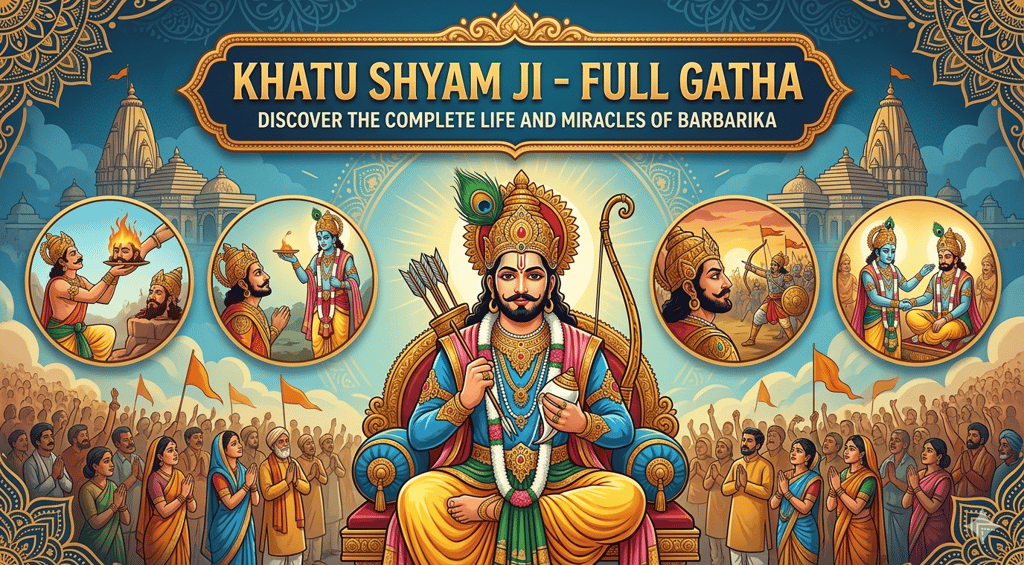
Khatu Shyam Ji is a popular Hindu deity worshipped especially in western and northern India, and he is believed to be the reincarnation or manifestation of Barbarika, a legendary warrior from the epic Mahabharata.
In the Mahabharata tradition, Barbarika is described as the grandson of Bhima (one of the five Pandava brothers) and the son of Ghatotkacha and Maurvi (Morvi), making him part of the Pandava family line.
Because of a special blessing from Lord Krishna, Barbarika is worshipped in the present age (Kali Yuga) under the loving name “Shyam”, which is one of Krishna’s own names, referring to his dark, beautiful complexion.
Birth and family background
According to devotional legends, Barbarika was born in ancient India before the great Kurukshetra war, the central battle in the Mahabharata.
His father Ghatotkacha was a mighty warrior with magical powers, born to Bhima and the forest-demoness Hidimba, and his mother Maurvi (also called Ahilawati or Morvi) was herself a brave and skilled warrior princess.
Growing up, Barbarika heard many stories about his grandfather Bhima’s strength and the coming conflict between the Pandavas and the Kauravas, which inspired him to train seriously as a fighter from a very young age.
Barbarika’s training and divine weapons
Barbarika learned the art of warfare from his mother, who trained him in archery, swordsmanship, and battlefield strategy.
As he grew older, he performed intense spiritual practices and austerities to please the gods, and different traditions say he worshipped Lord Shiva, the Goddess (Durga/Chandi), or both.
Moved by his devotion and courage, the Goddess or Shiva granted him three infallible arrows, and the fire-god Agni gave him a powerful bow with which he could theoretically conquer all three worlds (heaven, earth, and the underworld).
These arrows are the reason he is often called “Teen Baan Dhaari” – the Bearer of Three Arrows.
The power of the three arrows
Devotional stories describe Barbarika’s three arrows (called Teen Baan) in a special way to show their supernatural power.
Common versions say:
With the first arrow, Barbarika could mark all targets he wanted to destroy.
With the second/third arrow, he could then actually destroy every marked target in one stroke.
After finishing its task, the arrow would return to his quiver, making it effectively impossible to waste.
Because of this, Barbarika used to say that one single arrow was enough to end an entire army, and that he did not really need all three to win a war.
The vow: always support the weaker side
When Barbarika learned that the great Mahabharata war between the Pandavas and the Kauravas was about to begin at Kurukshetra,
He wanted to go and either witness or participate in this decisive battle.
Before leaving home, his mother reminded him of the importance of justice and compassion, and he made a solemn vow to her:
“In any war, I will always support the side that is weaker, losing, or oppressed.
This vow is crucial to his story, because it later creates a serious cosmic and moral dilemma in the Mahabharata war.
This promise to always stand with the weaker is also the spiritual root of one of Khatu Shyam Ji’s most famous titles in modern devotion:
“Hāre kā Sahara” – ‘Support of the Defeated’
Barbarika sets out for Kurukshetra
Armed with only his three divine arrows and his bow, Barbarika set out on horseback towards the battlefield of Kurukshetra.
Some devotional traditions even mention that his horse was blue, which is why later songs sometimes call Khatu Shyam “the Lord on the blue horse”,
In any case, the image is striking: while the two great armies had thousands of warriors, chariots, and elephants,
Barbarika rode alone, carrying only three arrows—but arrows that could destroy everything.
Krishna appears as a Brahmin
Lord Krishna, the central divine figure in the Mahabharata, knew that a mysterious,
Extremely powerful young warrior was heading towards the battlefield.
As the all-knowing divine being, Krishna understood that Barbarika’s power and his vow to support the weaker side could completely
unbalance the war and disturb the plan of Dharma (righteousness).
To examine Barbarika and to understand his intentions, Krishna disguised himself as a simple Brahmin (a priest/sage) and stood on the road where Barbarika would pass.
When Barbarika arrived, Krishna stopped him and, in the humble Brahmin form, asked where he was going with such a small “army”, noticing that Barbarika had only three arrows and a bow.
The test with the peepal tree leaves
In many versions of the story, the disguised Krishna mildly mocked Barbarika, saying something like:
“Are you going to this enormous battle with just these three arrows? How can you hope to fight?”
Barbarika calmly replied that one arrow was enough for him to finish any opponent,
and that three arrows were more than sufficient to win the entire war.
To test this claim, Krishna pointed to a peepal (sacred fig) tree under which he was standing and challenged Barbarika:
“If you are so confident, use a single arrow to pierce all the leaves on this tree.”
Barbarika agreed, took one arrow, meditated briefly, and released it towards the tree.
The arrow flew with divine intelligence, piercing every visible leaf, circling around the tree with great speed.
To push the test further, Krishna secretly hid one leaf under his foot, hoping that the arrow would miss it.
However, after striking all the visible leaves, the arrow began to circle around Krishna’s foot, indicating that it knew there was still one leaf hidden there.
When Krishna asked why the arrow was circling his foot,
Barbarika explained that there must be a leaf under his foot, and that the arrow would not stop until it had pierced that last leaf as well.
Realizing this, Krishna moved his foot, the arrow pierced the hidden leaf, and then returned to Barbarika’s quiver,
proving that Barbarika’s weapons were indeed supernatural and infallible.
The deeper problem: Dharma at risk
After testing Barbarika’s power, Krishna (still in Brahmin disguise) asked which side he planned to support in the war.
Barbarika honestly answered that he had vowed always to fight for the side that was weaker or losing.
Krishna now explained the problem: at the start of the war, the Pandava army was smaller and would appear weaker, so Barbarika would fight for the Pandavas; once he joined them, his presence and his three arrows would make the Pandavas overwhelmingly strong, and the Kauravas would then become the weaker side.
Because of his vow, Barbarika would then switch sides and fight for the Kauravas, making them suddenly strong and the Pandavas weak again, this process would repeat, causing both sides eventually to be completely destroyed while only Barbarika survived.
If that happened, the war would no longer serve its higher purpose:
The Mahabharata war was meant, in devotional understanding, to destroy injustice and establish Dharma (righteousness),
Not to annihilate everyone through the power of a single warrior.
So Krishna saw that Barbarika’s combination of immense power and unbending vow could destroy the balance of cosmic justice.
Krishna’s request: the gift of the head
Seeing this cosmic danger, Krishna decided that Barbarika must not participate in the war,
But he also recognized Barbarika’s sincere devotion and warrior spirit.
He therefore chose a path that would both honor Barbarika’s greatness and protect the balance of Dharma.
In his Brahmin form, Krishna told Barbarika that as a Kshatriya (warrior) and a powerful hero,
He was also expected to be charitable and to offer guru-dakshina—a traditional gift to the spiritual teacher.
Barbarika replied that he was ready to give anything under his control as a gift.
Krishna then asked for an unimaginable donation:
“I want you to give me your head as charity.”
Surprised, Barbarika realized that no ordinary Brahmin could ask for such a gift and asked Krishna to reveal his true identity.
In response, Krishna dropped his disguise and appeared in his divine form, showing that he was the Supreme Lord himself.
Barbarika’s sacrifice: the “Donor of the Head”
Once Barbarika understood that it was Lord Krishna himself who was asking, he did not hesitate.
He bowed and humbly agreed to give his head as an offering, seeing this not as a loss but as the highest opportunity to serve God and Dharma.
According to the legend, Barbarika made one request before fulfilling this sacrifice:
He wanted to witness the entire Kurukshetra war from beginning to end.
Krishna granted this wish and promised that Barbarika’s head would be kept alive and conscious, so he could watch the battle with divine sight.
Then Barbarika cut off his own head and offered it at Krishna’s feet, completing one of the greatest acts of sacrifice in Hindu devotional literature.
Because of this supreme sacrifice, he is lovingly remembered as “Sheesh ke Daani” – “the Donor of the Head”.
Some traditions add that Goddess Chandika (a fierce form of the Divine Mother) sprinkled his severed head with nectar,
Making it immortal so it could remain alive to witness the war.
The silent witness on the hill
Krishna then took Barbarika’s head and placed it on the top of a hill overlooking the battlefield of Kurukshetra,
So that the head could see everything that happened below.
For all eighteen days of the Mahabharata war,
Barbarika’s head watched silently as soldiers fought, heroes fell, and Dharma slowly triumphed over Adharma (unrighteousness).
Devotional retellings say that from this elevated position, Barbarika saw not only human warriors, but also the divine forces at work—how Krishna’s guidance, his Sudarshan Chakra (divine discus), and his subtle interventions shaped the outcome of the war.
After the war: “Who really won?”
After the war ended, the Pandavas were declared victorious, and the Kauravas were destroyed.
Like many human beings after a success, the warriors began to argue among themselves about whose heroism and skill had truly won the war—
each one felt that his own role was the most important.
To end this ego-driven debate, Krishna suggested that they should ask Barbarika’s head, which had watched the entire war without taking sides.
The Pandavas and Krishna went to the hill where the head was placed and asked:
“From your point of view, who actually won this war? Whose power brought us victory?”
Barbarika’s head replied with deep spiritual insight that, from his perspective, he saw no individual warrior as the real winner.
He said he had seen only Krishna’s will and Krishna’s weapons acting everywhere—he saw the Sudarshan Chakra moving, he saw divine power striking at the right moments, and he understood that it was Krishna alone who had truly won the war, using the heroes as instruments.
This teaches a central spiritual lesson of the story: human beings are instruments, while the real doer is the Divine.
Krishna’s boon: Shyam of Kali Yuga
Deeply pleased and moved by Barbarika’s devotion, sacrifice, and humility, Krishna granted him a very special boon (blessing).
Krishna declared that:
In Kali Yuga (the current spiritual age), Barbarika would be worshipped in Krishna’s own name, “Shyam”, and people would experience him as a compassionate form of Krishna.
Anyone who worships him with sincere faith and chants his name from the heart would have their wishes fulfilled and their difficulties removed.
He would be especially known as the helper of those who have lost and the support of the defeated, hence the title “Haare ka Sahara” (Support of the Defeated).
Because of his generosity and the belief that he showers blessings on countless devotees, he is also called “Lakhdataar”, which literally means “the giver to lakhs (hundreds of thousands)” or “the great benefactor who gives in abundance”.
Thus, the warrior Barbarika became Khatu Shyam Ji, a beloved deity of compassion, support, and miraculous help in times of distress.
The journey of the head: from river to Khatu
According to temple legends, after the war Krishna immersed Barbarika’s head in the River Rupawati, giving it rest while keeping the earlier boon for the future age.
When Kali Yuga began—the age in which we are believed to live now—the time came for Barbarika to reappear as Shyam for his devotees
In the village of Khatu in the Sikar district of Rajasthan (north-west India), something miraculous began to happen: a cow would come to a particular spot and let her milk flow spontaneously onto the ground every day, without anyone milking her.shrikhatushyamjimandir.
The villagers were surprised by this strange event and decided to dig at that spot to see what was hidden beneath the earth.shrikhatushyamjimandir.
They discovered a buried head, believed to be Barbarika’s head, still charged with divine energy
A local priest worshipped the head for some time, and then the local ruler, King Roop Singh Chauhan, had a dream in which he was instructed to build a temple at that place and install the head as the main deity.
The Khatu Shyam Temple in Rajasthan
Following this divine instruction, King Roop Singh Chauhan built the first Khatu Shyam Temple in Khatu, installing Barbarika’s head as “Khatu Shyam Ji”.
Historical and temple sources say that the first main temple construction dates to around 1027 CE, with later renovations and expansions over the centuries, especially in the 18th century.
The current temple is built mainly of white Makrana marble (the same high-quality marble used in the Taj Mahal), with beautiful silver-plated doors and richly painted halls.
Inside, the main idol (murti) of Shyam Baba is installed, and nearby is a sacred pond called Shyam Kund, associated with the place where the head was found.
The temple has become one of the most important pilgrimage sites in Rajasthan, attracting millions of devotees each year, especially from Rajasthan, Haryana, and neighboring regions.
Festivals, Phalgun Mela, and modern devotion
One of the most famous events at Khatu Shyam Ji Temple is the Phalgun Mela, a large annual fair held around February–March in the Hindu month of Phalguna, close to the festival of Holi.
During this period, huge crowds of devotees walk barefoot to Khatu, carrying flags (called “nishan”), coconuts, and offerings, while continuously chanting the name of Shyam.thejhunjhunu.
Devotees believe that Khatu Shyam Ji fulfills the wishes of those who approach him with a pure, sincere heart and that he especially listens to those who are in despair, defeat, or deep trouble.
That is why the slogan “Haare ka Sahara Baba Shyam Hamara”—“Shyam Baba is the support of the defeated”—is widely sung in songs and chanted in temples and gatherings.
He is also affectionately called “Lakhdataar”, meaning “the giver to lakhs (hundreds of thousands)” and also, in another sense, the one who “perceives (lakhna) and understands his devotees’ hearts even before they speak”.
Other regional forms and names
The figure of Barbarika/Khatu Shyam appears in different regional traditions under various names, reflecting how the same spiritual figure is absorbed into local culture.
In Gujarat, for example, a form of this deity is sometimes associated with “Baliyadev”, a local guardian god.
In parts of Nepal, some traditions connect Barbarika with Akash Bhairav or identify him with a legendary king named Yalambar, though these links are regional and not universally accepted.
Regardless of regional variations, the core idea remains: a powerful warrior, deeply devoted to God, who made the ultimate sacrifice and is now worshipped as a compassionate helper of devotees in the present age.
Spiritual lessons from the story
For foreigners or newcomers trying to understand why this story is so beloved, it helps to see the spiritual messages that Indian devotees draw from it.
Sacrifice and humility are greater than power
Barbarika had the power to destroy armies with a single arrow, yet the most remembered part of his life is not his strength but his willingness to give up his head at God’s request.
This teaches that in Hindu spirituality, sacrifice, surrender, and humility are valued even more than raw power.
Stand with the weak and defeated
His vow to always support the weaker side is why he is called “Haare ka Sahara” – Support of the Defeated.
Devotees believe they can come to him precisely when they feel lost, broken, or defeated in life, and that he will stand with them.
God is the true doer, we are instruments
When Barbarika’s head says he saw only Krishna’s power acting in the war, it reflects the idea that God is the ultimate doer, while human beings are instruments of a higher will.
This encourages humility and faith, even when we achieve success.
Simple devotion in a difficult age
Krishna’s boon that Barbarika will be worshipped as Shyam in Kali Yuga and that simply remembering him with faith can remove difficulties, reflects a key Hindu belief that in this spiritually “heavy” age, simple devotion and heartfelt prayer are enough to connect with the divine.
Cutting off the “head” of ego
Symbolically, many teachers say that while Barbarika literally gave his physical head, ordinary people are invited to “offer the head of ego”—to let go of pride and surrender to a higher wisdom.
In one line: who is Khatu Shyam Ji?
Putting it all together, Khatu Shyam Ji is Barbarika, the grandson of Bhima, a warrior blessed with three infallible arrows, who vowed to support the weaker side, offered his head to Krishna to protect Dharma, watched the Mahabharata war as a silent witness, and was granted the boon to be worshipped in Kali Yuga as Shyam, the support of the defeated and the generous giver to countless devotees.
खाटू श्याम बाबा की पावन गाथा
जय श्री श्याम! जय श्रीकृष्ण! जय शीश के दानी, खाटू वाले श्याम बाबा की जय!
आज हम सब मिलकर उस करुणामय, दयालु, हारे के सहारे खाटू श्याम बाबा की पावन गाथा सुनेंगे, जिनका असली नाम है – महावीर वीर बर्बरीक।
वही बर्बरीक, जो महाबली भीम के पौत्र और घटोत्कच के पुत्र हैं, जिनके शीश के दान ने उन्हें कलियुग का तारणहार बना दिया, और जो आज “खाटू श्याम”, “तीन बाणधारी”, “शीश के दानी” और “हारे का सहारा” नाम से संसार भर में पूजे जाते हैं।
प्रस्तावना: खाटू वाले श्याम कौन हैं
कथाओं में आता है कि महाभारत काल में एक अद्भुत वीर आत्मा का अवतरण हुआ, जिसका नाम था बर्बरीक। ये कोई साधारण योद्धा नहीं थे – ये थे पाण्डवों के वीर भीमसेन के पौत्र, उनके पुत्र घटोत्कच और माता मौरवी (अहिलावती) के लाड़ले सुपुत्र।
यही बर्बरीक आगे चलकर, भगवान श्रीकृष्ण के वरदान से, कलियुग में “श्याम” नाम से जाने गए, और राजस्थान के सीकर जिले के छोटे से गाँव खाटू के अधिष्ठाता देव बने – जिन्हें हम प्रेम से कहते हैं “खाटू वाले श्याम बाबा”।
बर्बरीक का जन्म और बाल्यकाल
महाभारत के युद्ध से पहले, जब धरती पर अधर्म बढ़ रहा था, तब भगवान की योजना के अंतर्गत भीम पुत्र घटोत्कच के घर में एक असाधारण बालक का जन्म हुआ – यही थे वीर बर्बरीक।
बाल्यकाल से ही बर्बरीक बड़े वीर, पराक्रमी और युद्ध-कला में निपुण थे; उन्होंने अपनी माता से, फिर देवी और महादेव की तपस्या से, अद्भुत अस्त्र–शस्त्र और सिद्धियाँ प्राप्त कीं। कथाओं के अनुसार उन्होंने महीसागर संगम के गुप्त क्षेत्र में नवदुर्गा की कठोर तपस्या कर दिव्य बल पाया, और फिर भगवान शिव से घोर तप करके तीन अभेद्य बाणों का वरदान मिला – यहीं से उनका नाम पड़ा तीन बाणधारी।
अग्निदेव भी उनके तप से प्रसन्न हुए और उन्हें एक ऐसा दिव्य धनुष प्रदान किया, जिसके बल पर वे तीनों लोकों पर विजय प्राप्त करने की क्षमता रखते थे।
तीन बाण और उनकी महाशक्ति
अब ज़रा सोचें, कौन-से ऐसे तीन बाण होंगे जो पूरे महाभारत को हिला दें? यही थे बर्बरीक के तीन अमोघ बाण। इन बाणों की शक्ति कुछ यूँ बताई जाती है:
पहला बाण: जिस–जिस वस्तु या योद्धा पर चलाया जाए, वह उन सब पर “निशान” लगा देता है।
दूसरा बाण: कुछ वर्ज़नों में रक्षा–चिन्ह या चयन का काम करता है।
तीसरा बाण: जिन पर निशान लग चुका है, उन सबका एक साथ विनाश कर देता है और फिर स्वयं लौट कर तूणीर (तरकश) में आ जाता है।
इसीलिए बर्बरीक बड़े विश्वास से कहते थे – “मेरा एक ही बाण शत्रु–सैन्य को समाप्त करने के लिए पर्याप्त है; अगर तीनों बाणों का प्रयोग हो जाए, तो पूरा ब्रह्मांड तक विनष्ट हो सकता है।”
हारने वाले का साथ देने की प्रतिज्ञा
जब महाभारत का युद्ध तय हो गया, तो यह समाचार वीर बर्बरीक तक भी पहुँचा। उन्होंने अपनी माता से युद्ध में जाने की इच्छा व्यक्त की; तब माता ने कहा – “बेटा, युद्ध में हमेशा हारे हुए, दुर्बल, पीड़ित पक्ष का साथ देना, जो पक्ष अन्याय से दब रहा हो, तुम उसका सहारा बनना।”
माँ की गोद में पलकर बड़े हुए बर्बरीक ने यह वचन सिर-माथे लिया और प्रतिज्ञा की – “मैं हमेशा हारे हुए पक्ष का साथ दूँगा, मैं हारे का सहारा बनूँगा।”
यहीं से उनका भाव आगे चलकर बहुत स्पष्ट रूप में सामने आता है – यही कारण है कि खाटू श्याम को आज भी “हारे का सहारा” कहा जाता है।
कुरुक्षेत्र की ओर प्रस्थान
प्रतिज्ञा लेकर, माता का आशीर्वाद सिर पर रखकर, वीर बर्बरीक अपने नीले रंग के घोड़े पर सवार होकर कुरुक्षेत्र की ओर निकले। हाथ में दिव्य धनुष, तरकश में केवल तीन बाण, शरीर पर वीरता की चमक, और हृदय में वचन–पालन का तेज – यही थी उनके प्रस्थान की पहचान। इसीलिए उन्हें “नीले घोड़े वाले श्याम” भी कहा जाता है।
श्रीकृष्ण से भेंट और शक्ति की परीक्षा
सर्वज्ञानी श्रीकृष्ण को पहले से ही आभास हो चुका था कि कोई अद्भुत वीर तीन बाण लेकर युद्धभूमि की ओर बढ़ रहा है। उन्होंने एक साधारण ब्राह्मण का वेश धारण किया और मार्ग में खड़े हो गए।
ब्राह्मण–रूपी श्रीकृष्ण ने उनसे पूछा – “पुत्र, तुम्हारे पास बस एक घोड़ा, एक धनुष और केवल तीन बाण? इतना बड़ा संग्राम, और तेरे तरकश में बस तीन तीर!”
वीर बर्बरीक ने विनम्र परन्तु दृढ़ स्वर में कहा – “ब्राह्मणदेव, मेरा एक ही बाण सारे शत्रु–सैन्य को समाप्त करने के लिए पर्याप्त है।”
श्रीकृष्ण ने परीक्षा लेने के लिए एक विशाल पीपल के वृक्ष के सभी पत्तों को एक ही बाण से भेदने को कहा। बर्बरीक ने बाण चलाया और क्षणभर में पीपल के हर पत्ते को भेद दिया। श्रीकृष्ण ने एक पत्ता अपने पैर के नीचे छिपा लिया था, तो बाण उनके पैर के चारों ओर घूमने लगा। तब बर्बरीक ने कहा – “ब्राह्मणदेव, कृपा करके अपना चरण उठा लें, नहीं तो मेरा बाण आपके चरण को भी छलनी कर देगा।”
धर्मसंकट और शीश दान की माँग
बर्बरीक ने अपनी प्रतिज्ञा दोहराई कि वे हारने वाले पक्ष का साथ देंगे। श्रीकृष्ण ने हिसाब लगाया कि बर्बरीक के कारण युद्ध कभी समाप्त नहीं होगा, क्योंकि वे बार-बार पक्ष बदलते रहेंगे और अंत में सब समाप्त हो जाएगा।
धर्म की स्थापना के लिए श्रीकृष्ण ने ब्राह्मण के वेश में बर्बरीक से उनका शीश दान में माँग लिया। वीर बर्बरीक समझ गए कि यह कोई साधारण ब्राह्मण नहीं है। जब श्रीकृष्ण ने अपना वास्तविक स्वरूप दिखाया, तो बर्बरीक भाव-विभोर हो गए। उन्होंने बस एक इच्छा जताई – “प्रभु, मैं अपना शीश तो दान कर दूँगा, पर मुझे महाभारत युद्ध का साक्षी बना दीजिए।”
श्रीकृष्ण ने 'तथास्तु' कहा और वीर बर्बरीक ने हँसते–हँसते अपने ही हाथों से अपना शीश काटकर प्रभु के चरणों में अर्पित कर दिया।
अमर साक्षी और विजय का निर्णय
श्रीकृष्ण ने उस शीश को कुरुक्षेत्र के एक ऊँचे टीले पर स्थापित कर दिया। युद्ध समाप्त होने के बाद जब पांडवों में बहस हुई कि विजय किसकी वजह से हुई, तब बर्बरीक के शीश ने गवाही दी:
“प्रभु, मुझे तो रणभूमि में कोई और दिखाई ही नहीं दिया; जहाँ देखता, वहाँ आपका ही सुदर्शन चक्र घूमता दिखा। जीत भी आपकी, हार भी आपकी, सब कुछ आप ही थे।”
कलियुग के श्याम: वरदान
श्रीकृष्ण ने प्रसन्न होकर बर्बरीक को वरदान दिया:
“कलियुग में तुम मेरे ही श्याम रूप में पूजे जाओगे।”
“तुम 'हारे का सहारा' और 'लखदातार' कहलाओगे।”
“जो भी भक्त तुम्हारी शरण आएगा, उसकी झोली कभी खाली नहीं रहेगी।”
खाटू में शीश का प्राकट्य
युगों बाद, राजस्थान के खाटू गाँव में एक गाय प्रतिदिन एक निश्चित स्थान पर अपना दूध स्वतः बहा देती थी। जब उस स्थान की खुदाई हुई, तो वहाँ से बर्बरीक का दिव्य शीश प्रकट हुआ। राजा रूप सिंह चौहान को स्वप्न में मंदिर बनाने का आदेश मिला और इस तरह श्री खाटू श्याम धाम की स्थापना हुई।
जीवन के लिए संदेश
शक्ति से बड़ी भक्ति है: बर्बरीक ने शक्ति होने के बावजूद त्याग को चुना।
हारे का सहारा बनें: कमज़ोर और पीड़ित की मदद करना ही सबसे बड़ा धर्म है।
अहंकार का त्याग: सफलता के समय यह याद रखें कि सब ईश्वर की लीला है, हम सिर्फ निमित्त हैं।
शीश के दानी, खाटू श्याम बाबा की जय!
हारे का सहारा, खाटू श्याम हमारा!
Connect with us
Support@RadheySewa.com
+91 7053-008-008
ॐ नमो भगवते वासुदेवाय नमः 🚩
Dashrath Putra Foundation 🚩
Nurturing love like Shri Ram, spreading unity like Shri Bharat, Standing Strong like Shri Laxman, and Caring with Devotion like Shri Shatrughan